You’ve found the quartz color you want. Then someone mentions the seam, and you start picturing a line running right past your faucet. Before you worry, it helps to know what a seam is, when one is needed, and how a bathroom vanity top differs from a long kitchen counter.
What is a quartz countertop seam?
Quartz is manufactured in slabs of fixed size. When a counter runs longer than one slab or turns a corner, the fabricator cuts two pieces and joins them. That joint is the seam. It’s bonded with an adhesive tinted to match the stone, then polished flush with the surface.
A seam isn’t a defect. In a long kitchen run or an L-shaped counter, it’s a structural necessity. Even a well-made seam is still a line you might notice, though, especially on veined patterns or under bright bathroom lighting.
What makes a seam more or less visible?
Three factors decide how much a seam stands out:
- Pattern: Solid and finely speckled quartz hides a joint best. Bold veining has to be lined up across the cut, and any mismatch shows.
- Workmanship: Tight cuts, a well-matched adhesive, and a careful final polish separate a hairline joint from a visible stripe.
- Location: A seam near the sink sees water, soap, and daily wiping. It’s also where your eye lands most often.
Does a bathroom vanity need a seam?
Seams become necessary in three situations:
- The counter runs longer than a single slab.
- The layout includes an L-shape or corner return.
- One continuous counter spans two separate cabinets, such as a vanity and a makeup area.
A freestanding bathroom vanity rarely runs into these situations, which is why a top sized to the vanity is such a practical fit for bathrooms.
How RSV quartz tops are made to fit
At Rock Solid Vanities, we make our quartz tops in standard widths matched to each vanity, so the top arrives sized to fit your cabinet.
Olympia, RSV’s solid snow-white quartz, on a 48-inch Smoke vanity.
Each top is 1 inch wider than its cabinet, leaving a ½-inch overhang on each side. A 48-inch vanity takes a 49-inch top, and a 72-inch double sink takes a 73-inch top.
Every RSV quartz top comes with:
- A white undermount sink, installed at the factory
- A matching 4-inch backsplash, plus any side splashes your layout requires
- Your choice of single-hole, 4-inch, or 8-inch on-center faucet drilling
Need a top cut to fit snugly between two walls? Custom cuts are available for an additional charge, and your dealer will help you take the measurements.
The material is low-maintenance too. RSV quartz is non-porous, 92% natural quartz, and resistant to heat, scratches, and stains. It never needs sealing, and our stone tops are backed by a limited lifetime warranty.
Choosing a color: solid, speckled, or veined
When you’re choosing a vanity top, pattern is mainly a question of style. RSV offers eight quartz colors:
| Color | Look | Pattern |
| Olympia | Crisp snow white | Solid |
| Moondust | Warm gray with earthy tones and crystal flecks | Speckled |
| Shale | Soft gray with brown speckles and subtle veining | Speckled, light veining |
| Willow | Soft white with delicate gray veining | Soft veining |
| Cascade | Off-white with a cool green undertone and earthy veins | Veined |
| Rapture | Warm white with light brown marble-style veining | Veined |
| Nova | Warm sandy tones with textured caramel veins | Veined |
| Admiral | White streaks against a deep gray background | Bold veining |
Quartz colors read differently on screen than in person, especially veined patterns. Seeing samples next to your cabinet finish is the most reliable way to choose.

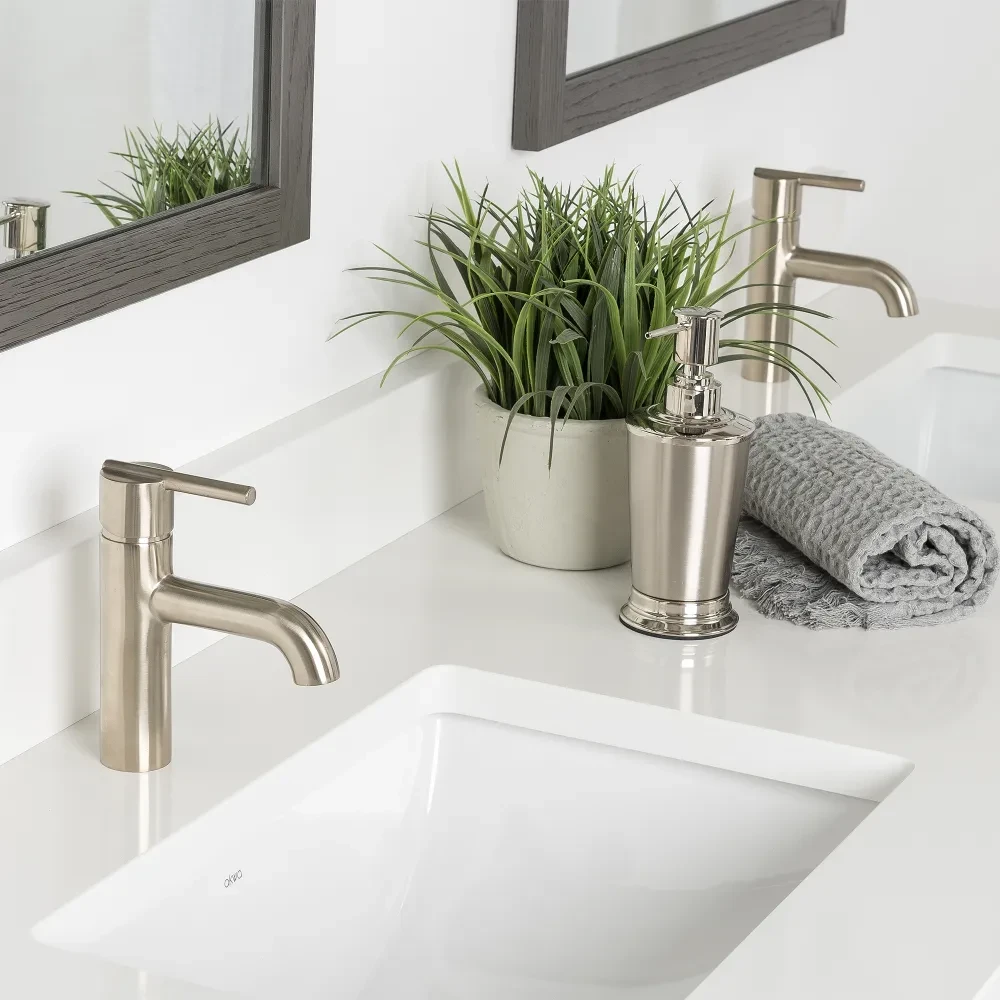
The Moondust quartz top on this white vanity demonstrates how solid color surfaces make quartz countertop seams far less noticeable during installation.
If your project does need a seam
If you’re also planning a long or L-shaped counter elsewhere in the home, a few requests will help your fabricator produce a cleaner joint:
- Place the seam away from the sink and the front edge, where hands and elbows rest.
- On veined quartz, ask how the pattern will be aligned across the joint.
- Ask for adhesive tinted to the stone’s background color, and look at photos of the fabricator’s past seam work.
The bottom line
Seams matter most on long runs and corner layouts. For a bathroom vanity, a quartz top made to fit the cabinet, with the sink installed at the factory, keeps things simple, so you can choose a color for how it looks. Every vanity sold also plants one tree through our Plant-a-Tree Promise.
Find a Dealer Near You to see all eight RSV quartz colors in person.
Frequently Asked Questions
Are seams in quartz countertops normal?
Yes, on any counter that needs more than one slab. Seams are most common on long runs and L-shaped counters.
Can quartz seams be completely invisible?
Rarely. Skilled fabrication can make a seam very hard to spot, but the most reliable way to avoid a visible seam is a top that doesn't need one. RSV quartz tops come in standard widths matched to each vanity, and you can see them in person through the Dealer Locator.
Will water get through a quartz seam?
A properly bonded and fully cured seam shouldn't let water through. Joints near a sink see the most moisture, which is why placement matters.
Does a quartz vanity top need sealing?
No. RSV quartz is non-porous, so it never needs sealing.