Most buying guides worry about humidity ruining a vanity. Colorado has close to the opposite problem: dry air nearly year-round, thin atmosphere, and sun intense enough at elevation to matter for anything with resin in it. Whether the project is a historic Denver bungalow or a mountain-town property outside Glenwood Springs, the climate math behind picking a vanity and countertop here runs differently than it does almost anywhere else on this list.
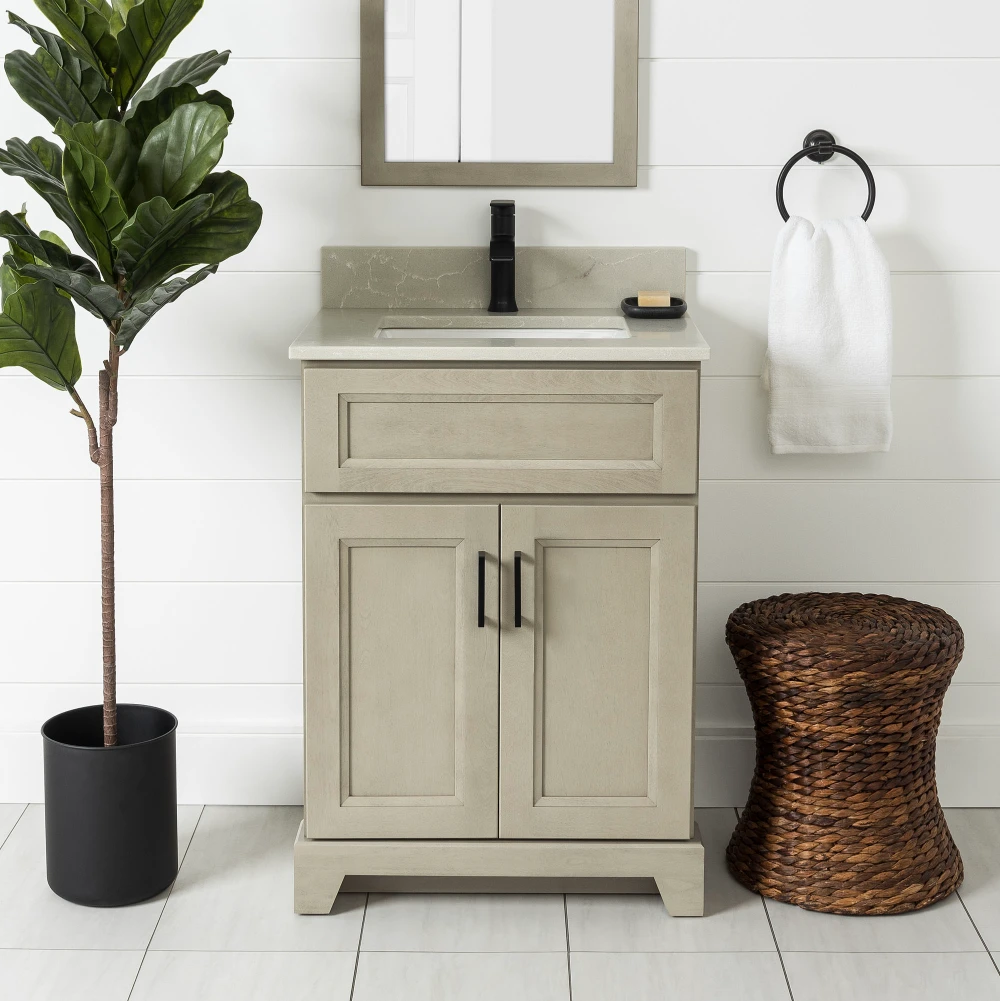
5 Things to Settle Before You Buy
- Get accurate measurements. Width, depth, height, and 21 inches of clearance in front of the vanity.
- Decide on sink count. A single basin suits one person; two or more people tend to prefer a double-sink setup.
- Locate your plumbing rough-in. Changing it after the fact adds cost you don’t need.
- Account for dry air and altitude UV. Both behave differently than the humidity concerns that drive material choice elsewhere.
- Budget beyond the vanity price tag. Installation, countertop, and hardware are additional costs.
| Related reading: |
Cabinet Materials for a Dry, High-Altitude Climate
Colorado flips the usual script. Instead of worrying about excess moisture warping cabinetry, the concern here is air so dry it can pull too much moisture out of solid wood, especially once winter heating kicks in.
Plywood handles that dry swing more predictably than solid wood does, since it’s less prone to shrinkage under sustained low humidity. Solid wood can still work well, but only with proper sealing to slow how much moisture it loses over a dry Colorado winter. MDF tends to do fine here, since its main weakness is excess moisture rather than dryness, which isn’t the state’s problem. Particleboard remains the budget option, and while dry air isn’t its enemy the way humidity is elsewhere, it’s still the least durable long-term.
Vanity Sizing for Colorado Homes and Mountain Properties
Older Denver neighborhoods and mountain-town properties around Glenwood Springs often work with smaller original bathroom footprints, where a 24- to 30 inch single-sink vanity is the practical choice. Newer Front Range construction generally allows for more generous primary bathrooms, where a 60 inch or larger double-sink vanity gives a household room to work independently.
Configuration should account for Colorado’s dry air as much as material selection does. Well-built drawer boxes and soft-close hardware hold their fit better through a dry winter than budget cabinetry does, since shrinkage at the joints is the main failure point in low-humidity climates. A center drawer tower is a practical addition for double-sink setups shared between two people.
Our What Is a Bathroom Vanity guide covers the basics of vanity types and configurations if you’re still deciding on layout.
Countertop Materials, Side by Side
| Material | Durability | Maintenance | Best For |
|---|---|---|---|
| Quartz | Very high | Low | Most bathrooms |
| Granite | High | Medium | Classic, natural look |
| Marble | Medium | High | Luxury bathrooms |
| Laminate | Low | Low | Budget renovations |
Because it’s engineered and non-porous, quartz simply doesn’t register Colorado’s low humidity or elevation one way or the other indoors. The one real factor: sustained, high-altitude UV exposure can fade the resin over years, so keep a quartz top away from constant direct sunlight rather than treating it like an outdoor-kitchen surface. Every Rock Solid Vanities quartz top ships in eight curated colors. See the full quartz tops collection to browse them.
Styles Colorado Homeowners Are Picking
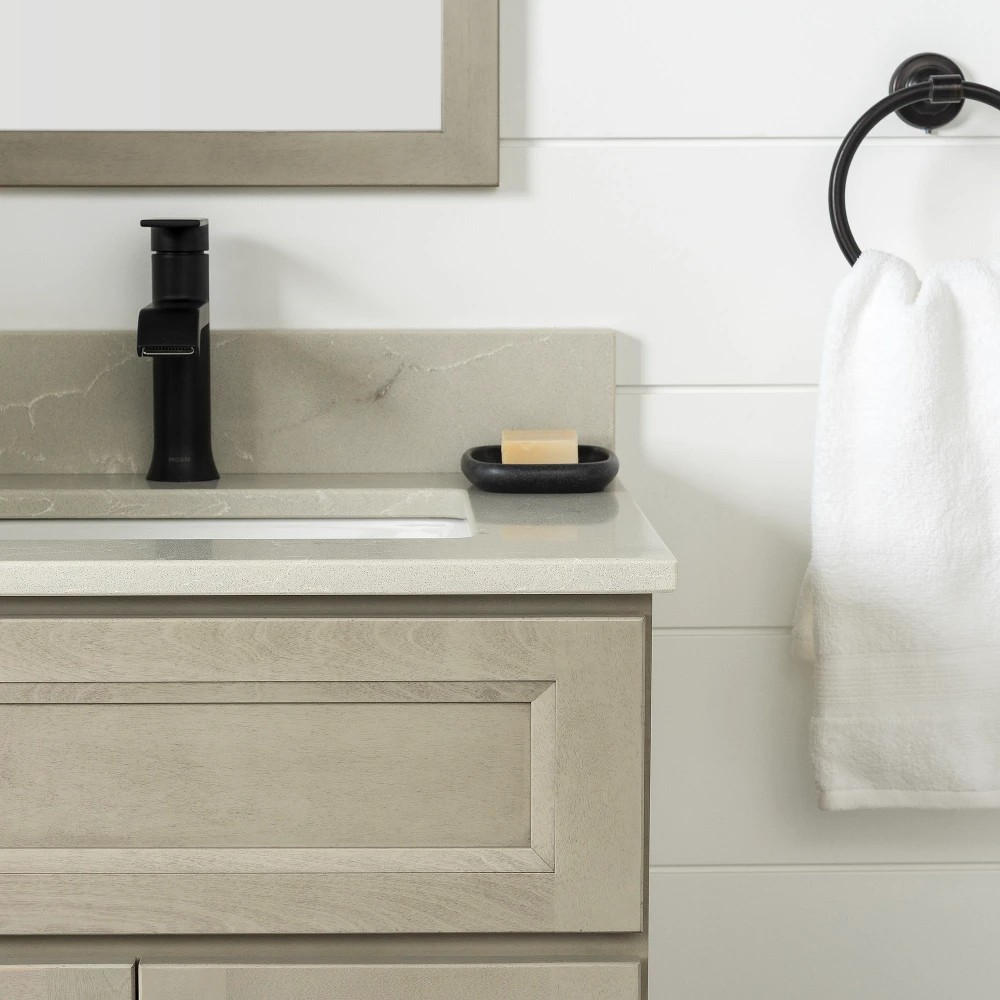
Denver’s older neighborhoods and mountain-town properties both lean toward traditional vanities, raised panels, and warm wood tones that suit a lodge-adjacent aesthetic. Newer Front Range construction and condo renovations trend the other way, toward wall-mounted, flat-panel designs that read clean and modern. Transitional vanities are the volume leader across the state overall, since they work equally well against natural stone or quartz.
Deep gray with contrast and warm neutral tones both photograph especially well against Colorado’s natural materials palette. Preview combinations in the Rock Solid Studio configurator before placing an order.
Rock Solid Vanities in Colorado
Rock Solid Vanities already has authorized dealers active in Colorado. Every quartz top is 1¼ inch thick, non-porous, and maintenance-free, and arrives with a factory-installed undermount sink and matching backsplash. Every vanity sold also helps plant a tree through the Plant-a-Tree Promise.
Where to find a dealer in Colorado:
| Region | Area Served | Dealer | Status |
|---|---|---|---|
| Denver Metro | Denver, Aurora, Lakewood | Martz Supply Company 500 W 53rd Place, Unit A, Denver, CO 80216 303-432-4281 | Active |
| Western Slope | Glenwood Springs, Aspen area | Dahl of Glenwood Springs 3366 S Glen Avenue, Glenwood Springs, CO 81601 970-945-2331 | Active |
| Colorado Springs | Colorado Springs, Pikes Peak region | — | Coming soon |
| Northern Colorado | Fort Collins, Boulder | — | Coming soon |
Use the Dealer Locator to find the Rock Solid Vanities showroom nearest you. Enter your ZIP code and it will pull up the closest authorized dealer, along with their address and phone number, so you can call ahead or stop by to see finishes and quartz colors in person.
Interested in carrying Rock Solid Vanities in your own showroom? Get in touch with our team about becoming an authorized dealer.
Frequently Asked Questions
Which states is Rock Solid Vanities available in?
Rock Solid Vanities are available across the United States, including Virginia, Tennessee, North and South Carolina, Pennsylvania, New Jersey, Michigan, Maryland, Illinois, Georgia, Florida, Delaware, Alabama, and Colorado. Enter your ZIP code on the Dealer Locator to find the closest authorized showroom.
What vanity size fits a smaller Denver-area or mountain bathroom?
Older Denver homes and many mountain-town properties fit a 24 to 30 inch single-sink vanity comfortably. Newer Front Range primary bathrooms typically have room for a 60-inch or larger double-sink vanity instead.